

Successors
When the Morris Mini De Luxe was released in March 1965, the Morris 850 became the basic low-cost offering in the Mini range, before being replaced with newer models.
A ‘standard’ variant remained part of the Australian Mini range until late 1972, with several models succeeding the Morris 850 over the seven-year period.
All models retained dry rubber cone suspension and a long centre exit gear change. This was while other sedans in the Mini range were upgraded to hydrolastic suspension and a remote gear change.
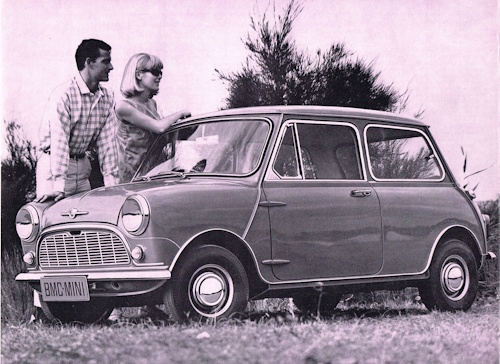
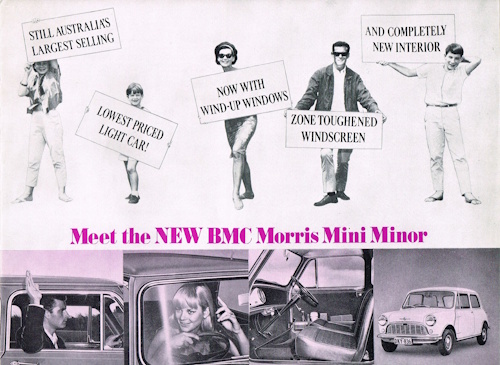
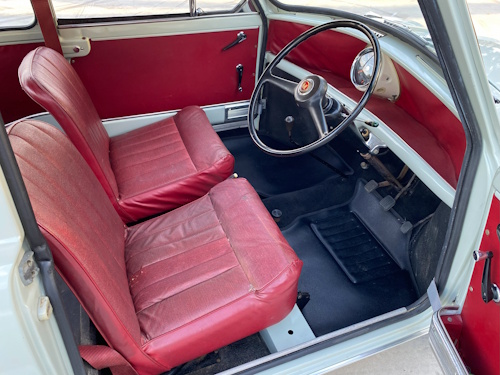
Morris Mini 1100
The Mark 2 (Mk 2) Morris Mini range arrived in 1969, including the Mini K and Mk 2 Cooper S. The most significant change was an 1098cc engine for all but the Cooper S (which maintained the larger 1275cc power unit).
The Mk 2 Morris Mini Minor was named the Morris Mini 1100 and featured the same engine and gearbox as the Mini K (the Mk 2 Morris Mini De Luxe). This now included synchromesh on all gears, but still with long centre exit gear lever.
Both the Mini K and Mini 1100 featured ‘Morris Mini 1100’ script on the boot lid, but the pressed steel front grille is a key distinguishing feature of the low specification model.
With the introduction of Australian Design Rules (ADRs) in 1969, the Morris Mini 1100 received the same essential changes as the rest of the Mini range. Most obviously this included burst proof ‘flappy handle’ doors in late 1970, with a limited number of cars being built with the new style of door (likely less than 100). Inside the car, a heater with windscreen demister was introduced.
Other changes in specification as time progressed included a key start in place of the floor starter switch in late 1969, and plain vinyl trim in place of patterned print vinyl.
The car type code for the Morris Mini 1100 is YG2S3. The 1098cc engine had the prefix code 10YJUH.
The production run was shorter than the Mini Minor, lasting only two years before concluding in 1971. Around 1,100 examples are believed to have been made (with reference to the Australian Mini Minor & Mini 1100 Register on Ausmini.com).
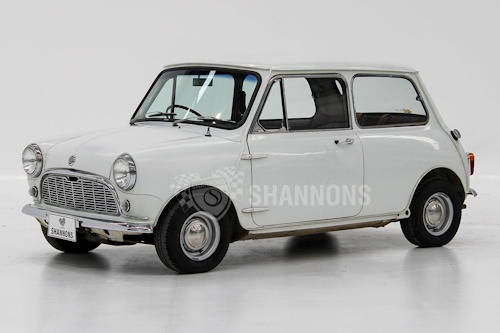
Mini 1100
The entire Australian Mini range was updated to feature the new ‘square nose’ front panels of the Mini Clubman in 1971. The Mini 1100 commenced production in July 1971 (Cripps et al. 2021, p. 56).
The Mini 1100 still featured a centre speedometer, missing out on the new gauges of the Mini Clubman.
The car type code for the square nose Mini 1100 is YG2S6. The 1098cc engine used a new format of prefix codes, with the 1000 series allocated to Mini 1100 and Van engines.
Less than 1,000 examples of the Mini 1100 are believed to have been built before production ended in early 1973 (with reference to the Australian Mini Minor & Mini 1100 Register on Ausmini.com; Cripps et al. 2021, p. 56).
Leyland Mini
With Australian Design Rules necessitating an increase in specification for even the most basic models, the gap between a basic model and a standard model gradually closed.
From 1973, the Mini Clubman, soon renamed to Leyland Mini, became the common offering of the Mini range. A basic model was no longer available.
Use in fleets
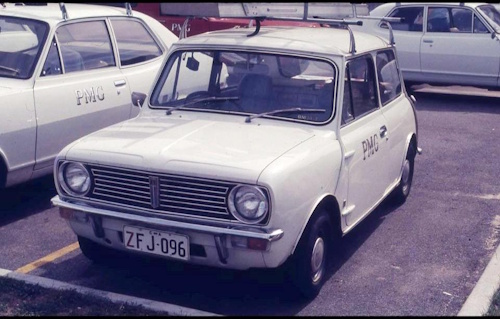
The basic models were popular with fleet buyers, often being specified in fleet colours. Known use in fleets (and their colours) include:
- NSW Police (light blue)
- Sydney County Council (SCC) (Silverpine Green), and
- Post Master General (PMG) Department (Birch Grey)
Further reading
The Mini Experience
The most detailed history that exists for the basic Australian Mini models was compiled by Craig Watson for The Mini Experience magazine.
The feature ‘Fleet Street’ was published in Issue 19 of The Mini Experience and Issue 1 of The Mini Experience Reloaded.
Registers
Little information is known about the production numbers of the basic models, with survivors also being unusual to find.
A car register on the Ausmini web forum exists in attempt to build a representation of production data by recording known details of cars, with the Australian Mini Minor & Mini 1100 Register relevant to the successor models.
The register can be accessed under the Mini Registers section of the forum, visible once logged in. The forum is free to join as a member.
References
See References for details of resources used to compile this page.
Last updated 21 March 2026