

Major milestone: 1% of cars reached on first anniversary
The Australian Morris 850 Register records more than 1% of cars produced after only a year of being online.
OCTOBER 10, 2025

After a public launch in October 2024, the Australian Morris 850 Register has grown to an incredible 630 cars.
Many owners and enthusiasts have submitted car details in the first twelve months of the public register, and it is with great thanks to them that the register has grown so significantly from the initial 450 cars.
With production of the Morris 850 having been 60,188 cars, there are now more than 1% of all cars recorded on the register.
While a single percentage is undoubtedly a small proportion of all cars, it nevertheless provides an opportunity to analyse both the cars recorded on the register as well as develop a general understanding of original production.
Sample
Upon the one-year anniversary, the register consists of 630 unique car records. Of these, 10 are records from original Passport to Service paperwork which include delivery dates but omit paint colour. Only the 620 complete records are considered for analysis.
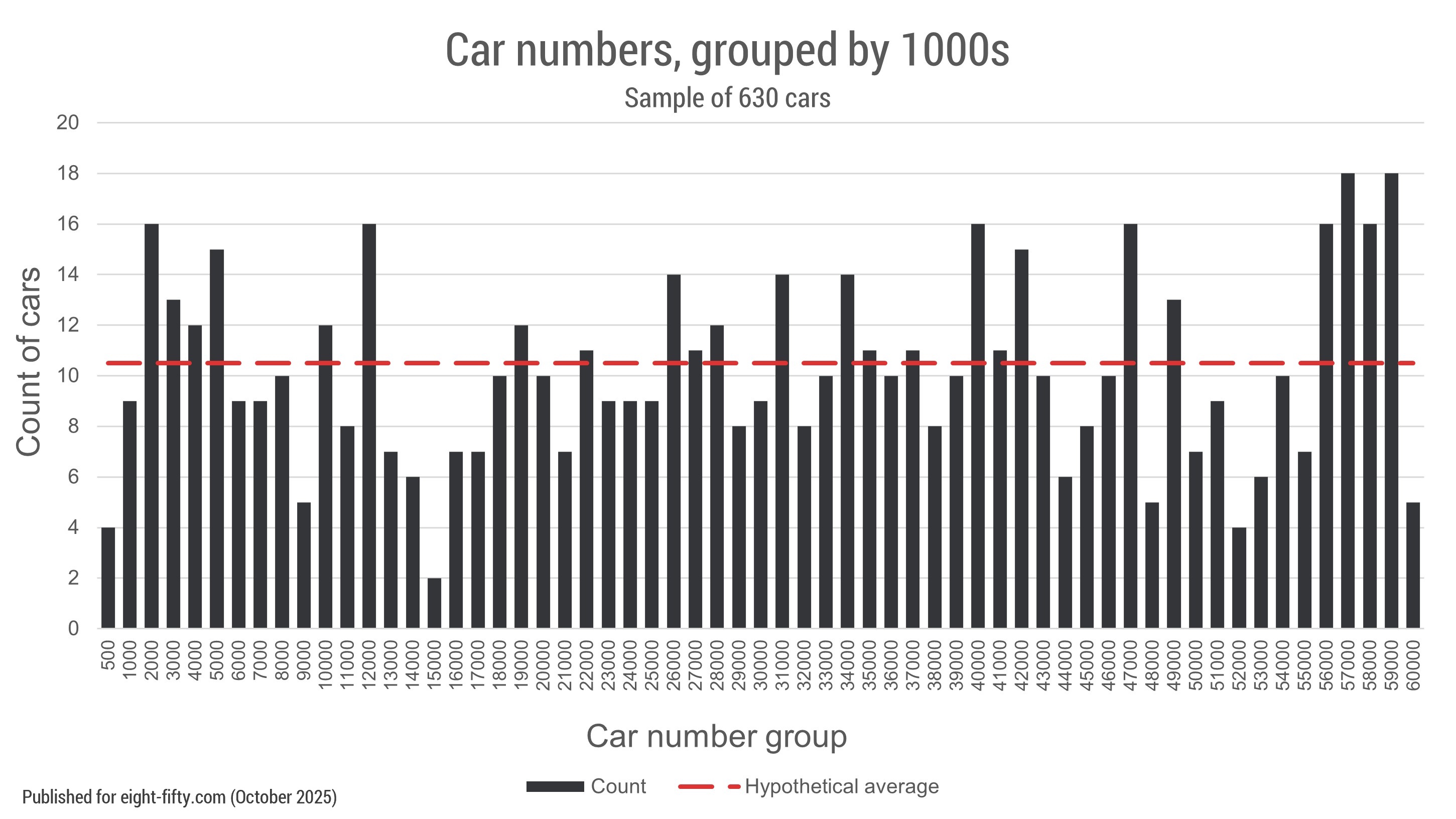
For an effective analysis, the 620 cars would be a random sample distributed across the entire production period. Hypothetically, 10-11 cars per thousand would be ideal.
The spread is somewhat varied in the actual 620 cars. Each thousand group is represented, however several have five or less while others exceed 15 (Figure 1).
If you have an 850 in the 15,000 range, it is currently underrepresented. Perhaps consider making a submission for your car to join the other two on the register!
Paint colours
Through the growth of the register, it has been possible to establish that at least 36 different paint colours were available on the Morris 850 over the entire production period.
Using the data from the register list, an assessment can be made of rare and common colours, both for the sample of cars on the register and an estimation of total production.
Register sample
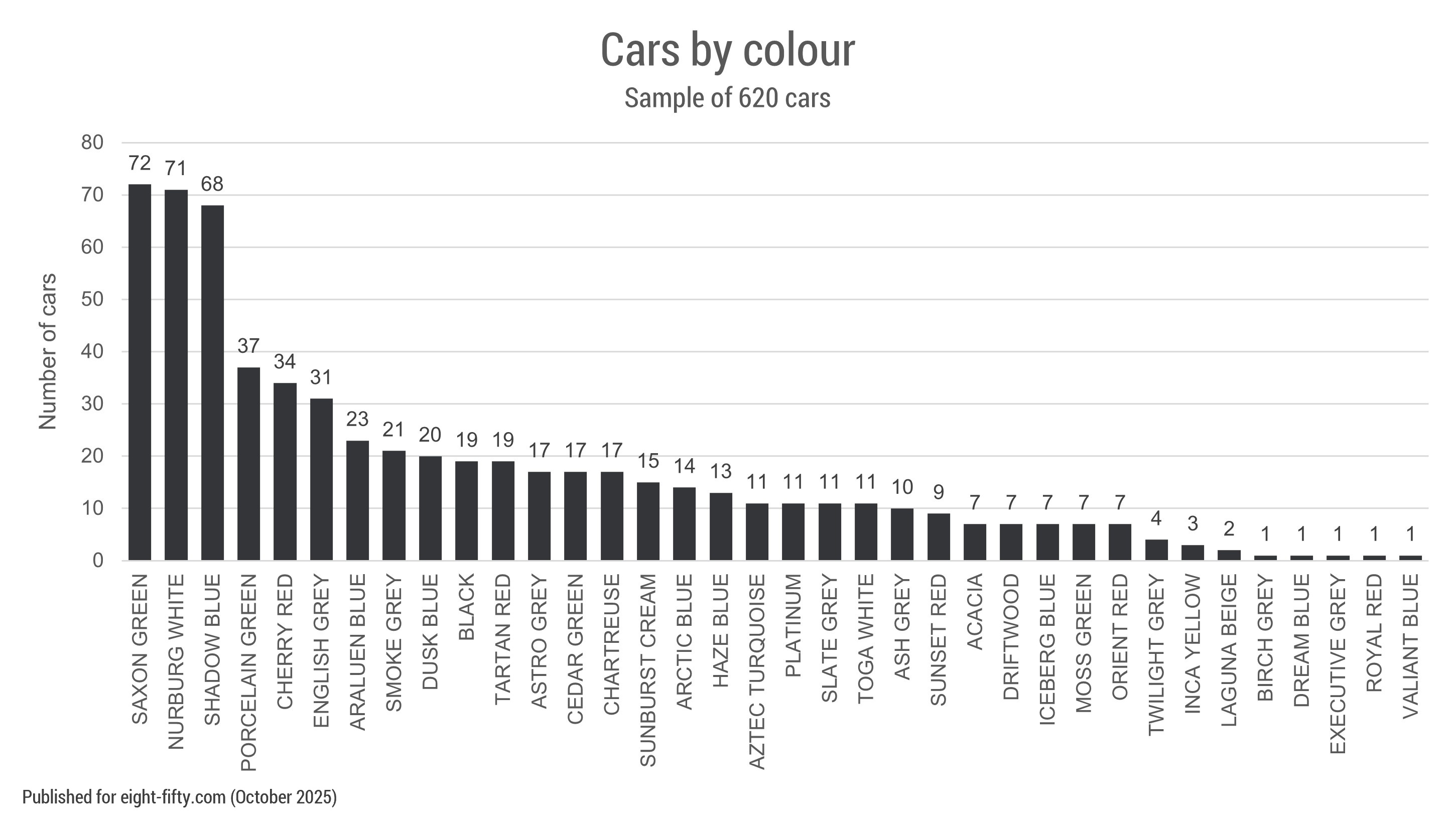
Three colours clearly lead the way for the most common on the register (Figure 2). Saxon Green, Nurburg White and Shadow Blue all have approximately 70 cars each.
Estimation of total production
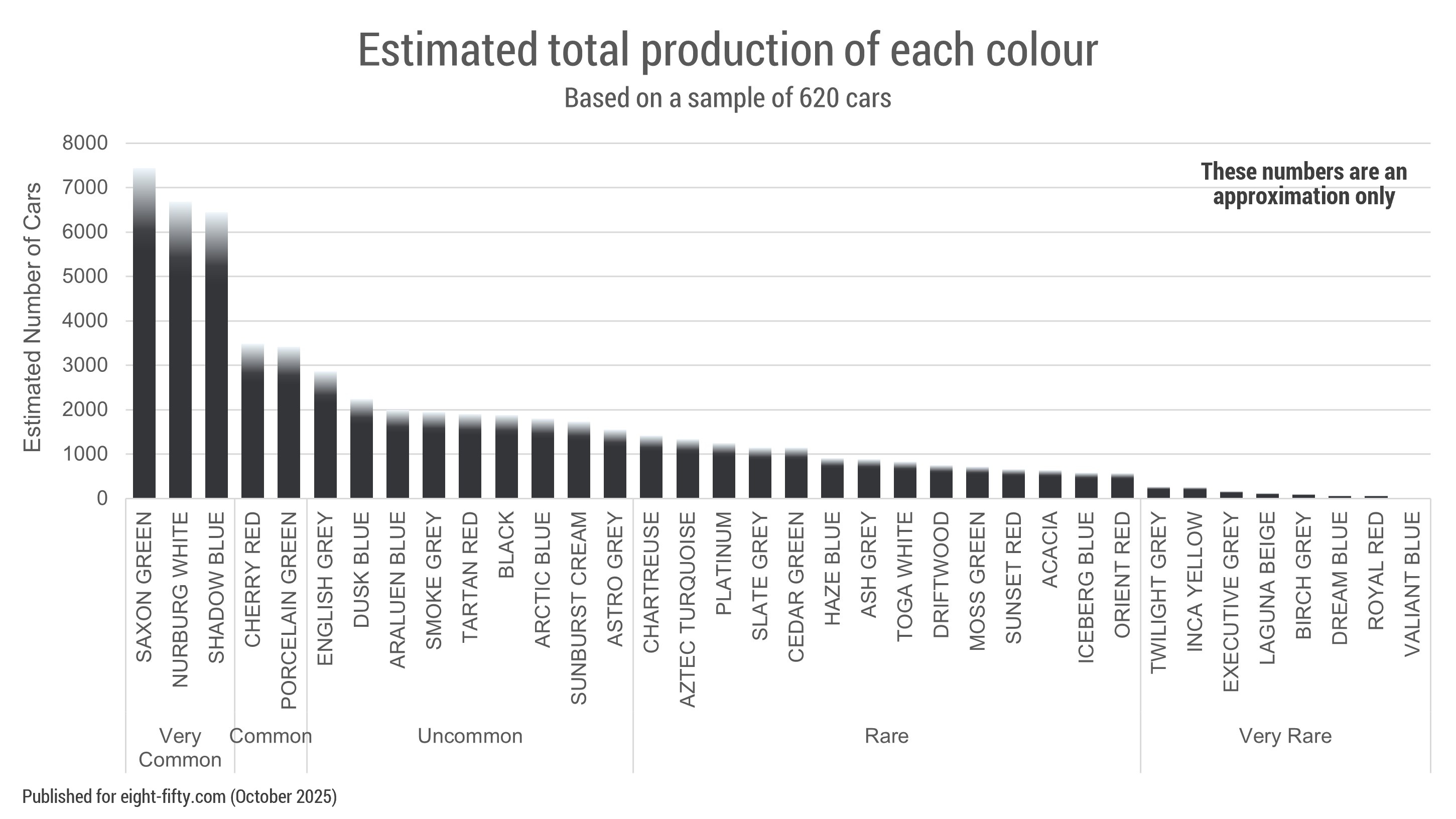
To estimate each colour’s rarity, the percentage of cars produced in that colour during its availability period is calculated. This is done by taking the colour’s share of cars on the register and applying it to the total cars produced in that period.
For example, Saxon Green was available for car numbers 9,000 to 37,999. Of 281 cars on the register in this range, 72 are Saxon Green (26%). Applying 26% to the 29,000 cars made gives an estimated 7,431 Saxon Green cars.
Naturally, this method is very much an approximation and uses a small sample set. It should only be used as a general indication and should not be used as a true figure of cars produced in each colour.
Colours have been grouped in five ‘rarity buckets’ – very common, common, uncommon, rare and very rare (Figure 3).
Very Common colours are the same three most popular colours from the register sample. From there, colours are in a similar order as the register sample, with only occasional changes in position.
At the Very Rare end of the scale, the colours are predominately those from late in production when production volume reduced following the launch of the Mini Deluxe. These include colours such as Dream Blue, Executive Grey, and Royal Red. Joining them are special order colours (Birch Grey and Valiant Blue), and Inca Yellow – a bright yellow available for only the first couple of thousand cars in 1961.
Status
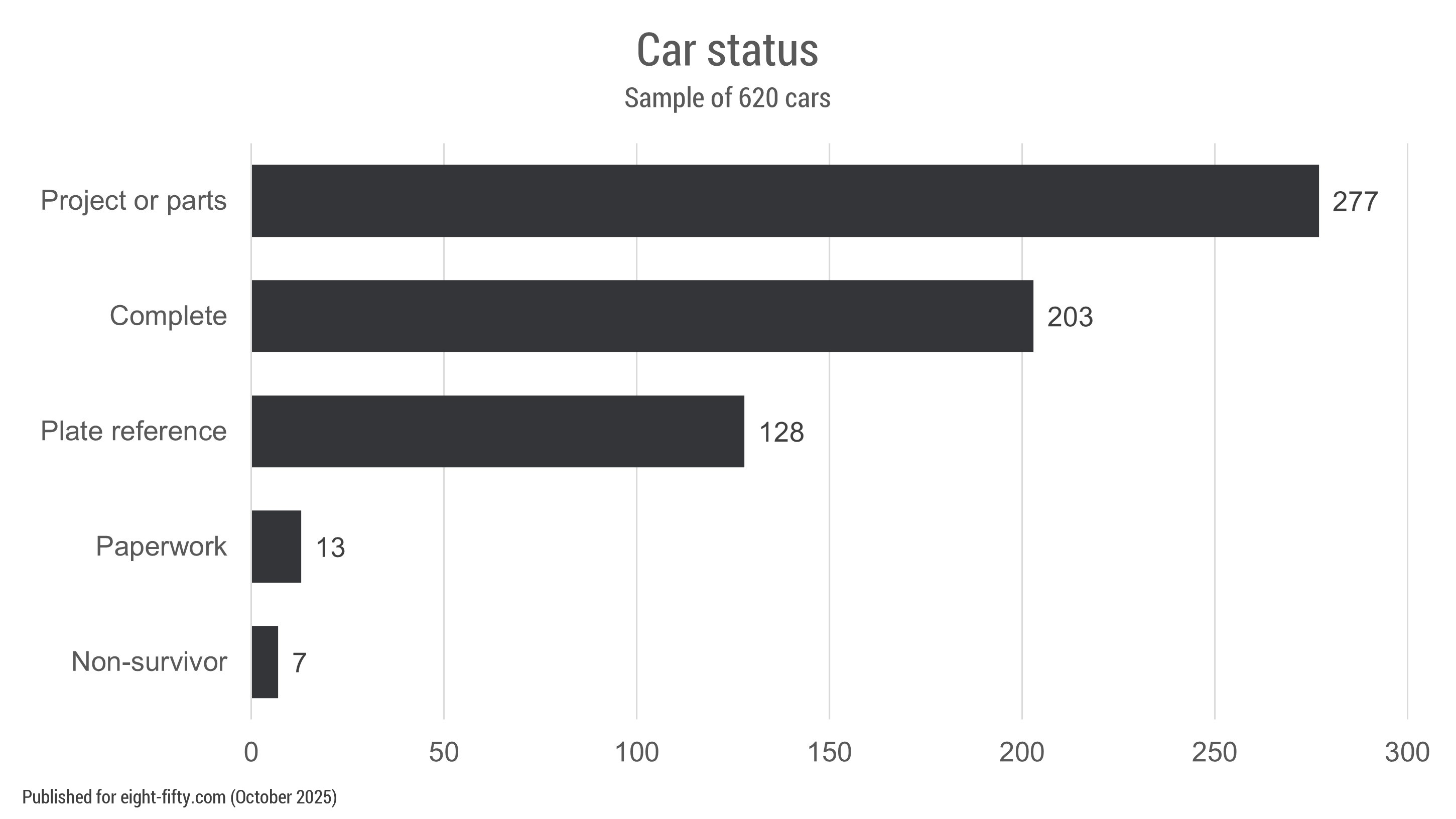
Included on the register list is a brief status of each car, provided for a quick reference to a car's condition or the source of information for the register (Figure 4).
There are five status types, which are kept high level and do not make a detailed assessment of the car:
- Complete - The car is complete and would be suitable to be road-going.
- Project or parts - The car is a restoration project or suitable for parts. Essentially the car still exists but is not complete or road-going.
- Non-survivor - The car is a non-survivor. This status is applied to the register cars very sparingly, only if it is confirmed that the car no longer physically exists in any form.
- Plate reference - The entry on the register was made with reference to an identification plate without detail of the car condition.
- Paperwork - The entry on the register was made with reference to paperwork, such as a Passport to Service or registration documents.
For the 620 sample cars, the most common status is ‘Project or parts’ (44%). This is to be expected, with it being the most general of all categories.
Almost a third of cars are complete vehicles, either on the road or stored.
Location
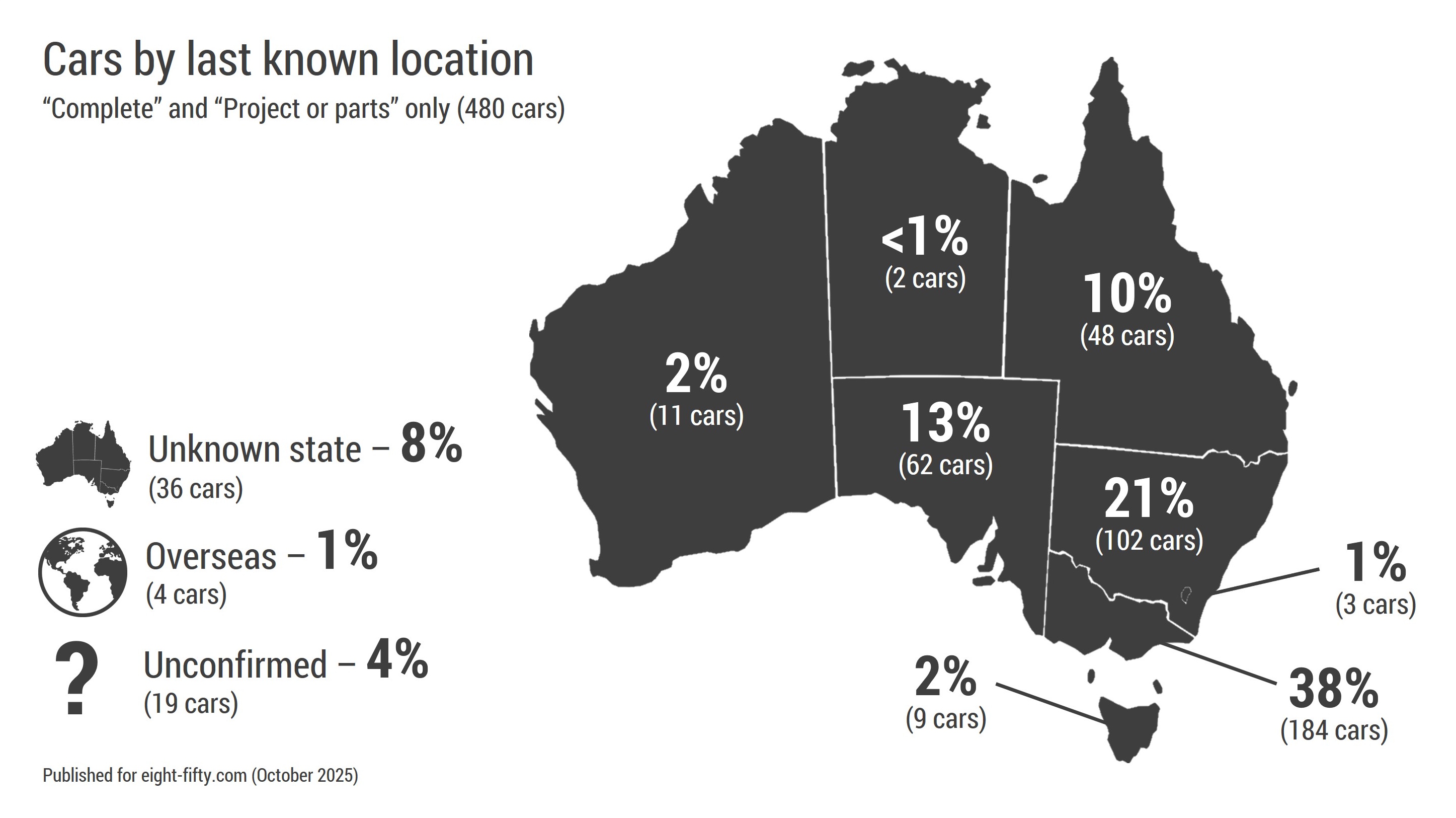
Taking a smaller sample and focusing only on cars that were known to exist at time of submission (‘complete’ and ‘project or parts’), the last known locations can be assessed (Figure 5).
For the reduced sample of 480 cars, the most common location is Victoria with 38% of cars. The results are no doubt skewed due to several key contributors to the register being Victorian based.
Coming in next is New South Wales, with a further 21% of cars. Together the two states have nearly 60% of cars on the register.
The location of 12% of cars is not state-specific or unconfirmed, while about 1% of cars are overseas.
It must be emphasised that this data is only for the sample set of cars on the register and should not be taken as a representation of the number of 850s still surviving. There are far more than 480 cars still in existence, we just don’t know about them yet.
Future growth
With 1% down, there are still many more cars to add to the register.
New submissions of cars are always welcome – whether you currently own the car, dismantled it in years gone by, or have paperwork sitting in a cupboard. Submissions can easily be made using the online form at any time.
The challenge is on to reach 2%!
Feedback
There is always room for improvement, and the register remains under constant review and updates. If you have any feedback or suggestions, please let us know.